





The math is pretty straightforward. There are only 168 hours in a week. But what we do with those hours is—and here's where we so often get into trouble—far less obvious.
Last week, I talked about accepting an inconvenient truth about our time. It's finite. The “container” of our lives has hard edges and we don't get to set them. We must accept that if we want to live a peaceful, sustainable, meaningful, and yes, successful life. We are human beings, and we perform best and flourish most when we act like it instead of pretending our limitations don't exist.
When we accept this truth we must also accept its natural implication: It's impossible to get it all done. Everything we want to do or need to do isn't going to fit. It's never happened, and it's not about to start happening. And, no, you and I aren't the exception to this rule, no matter how much we'd like to be.
Any attempt to squeeze more productivity out of your life through apps, systems, or tools with the goal of “finally being able to check everything off your list” is a fool's errand and will predictably lead to burnout, exhaustion, and ultimately failure to reach your potential in your work, your health, and your most important relationships.
Conversely, if you want to actually win at work and flourish in life, what actually works and respects your human limitations is to get crystal clear on your highest leverage work so you can dramatically reduce your hours. When you do this, you'll be able to invest far fewer hours in your workday without dropping or limiting your earning potential. Consequently, you'll get financial and time margin—both of which are necessary for winning and flourishing over the long haul.
How do I know this? I've lived it, studied it, and coached people through it as well. If we're going to make non-obvious but fruitful choices with our time, as I mentioned last week, we have to think in terms of investment.
Every minute you “spend” is an investment. You are now a financial advisor for your time. Your only goal is to invest every hour of your day for maximum return on that investment. Meaning, if you put an hour in, what do you have to show for it? Hopefully, something worth a lot more than one hour of your time. Certainly don't want to see a return worth less than an hour of your time.
If we focus on work, the most important question is, what is my highest-leverage work? Meaning, the activities that when I do them yield a disproportionate return on investment?
This is exactly what we teach people how to do in our Double Win Coaching program, and our clients consistently find that the clarity they walk away with enables them to drastically reduce their work hours and finally realize their professional and earning potential because their focus has shifted to delivering results instead of “getting things done.”

Finding Our True Priorities
Obviously, I can't explain everything our program teaches in a newsletter, but I do want to share with you one of the most powerful concepts we teach that helps you zero in on the work you should be prioritizing. It's called the Priority Filter.
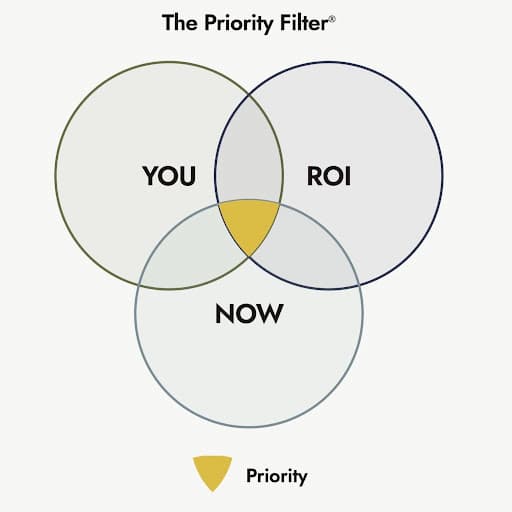
As you can see, it has three domains: You, ROI, Now. For those that don't know, ROI just means return on investment. It's how we talk about value. Some activities are more valuable than others.
Think of these like a decision tree whenever a request or demand on your time is made. And think about it as a simpler, more powerful replacement for the Eisenhower Matrix.
Your best investments are going to be smack dab in the center where all three of these domains overlap. Those should be activities you prioritize because they will yield a great return. So, let's take each domain one at a time.
You
This is the work that uniquely belongs to you. There are two things to consider here.
First, it's work that you're literally responsible and accountable for. It's in your job description, whether you have a written one or not. It's not work that lives on someone else's job description that you've taken responsibility for for some reason. This is a major trap for over-functioners. I have to guard against this myself.
Second, it's work that you are uniquely wired to do and have a passion for. You aren't just merely good at it. If you're already successful, which I suspect you are, you're probably competent at all kinds of things that other people could do and should be doing. So, “am I good at it” isn't a strong enough criteria for it being worth your time.
When you're wired for something, it means you're not just competent at the work, you're also exceptional at it. In fact, you're made for it. Not only do you have a singular passion for the work, you're better at it than almost anyone you know. It's the kind of work you find deep congruence with. It resonates with you.
This is the work that uniquely belongs to you. It's both your responsibility and leverages your natural wiring.
One thing to note here is that this is a qualitative criteria. We can't measure it in numbers, but we know instinctually or intuitively whether it's true or not. Some work just drains you, even if you're good at it. Other work makes you come alive.
Now let's shift to the quantitative.
ROI
We can assess whether our work meets the ROI criteria on an objective basis.
The question we want to ask ourselves here is this: Of all the things that I could do, of all the things on my list, which ones will deliver the highest return on the investment of my time? We're not asking which ones are merely valuable—probably most things on your list would make the cut by that criteria. We're asking, “which items are the most valuable?”
Remember, we're starting from the premise that you have limited time to invest (just like your money), so we've got to make it count unless you're okay with working 24/7—and I sure hope you're not.
If you're going to accomplish the same or better results in far fewer hours, we've got to make those hours earn their keep and produce bigger results per hour than what we're used to. This isn't magic math.
Some things on your list drive results more than others. Some don't have any quantifiable result you can pinpoint at all. Your most important work as a person who thinks about their time like investing their money is to start framing your time in terms of return on investment. What are you getting out of this meeting, this conversation, this project, this report?
And finally …
Now
We've answered the qualitative question (You), the quantitative question (ROI), and now we look at the qualifying question (Now).
What matters most now? This is where the Eisenhower Matrix fails. In all likelihood, you aren't wasting your time on things that are neither urgent, nor important. That's the easy stuff to get rid of. My guess is most everything you spend your time doing feels both urgent and important.
The problem is you're not qualifying that tightly enough. Like I said with ROI, everything may be valuable, but it's not equally valuable. Same thing here: Everything may be important, but it's not equally important. Similarly, while everything on your list is urgent, it's probably not all urgent today or even this week.
This is where nuance matters.
I experienced this recently when I was feeling overwhelmed. I told Joel, my husband, that I was just buried by all I was responsible for between work and home. You know those moments. I find it's often late at night, often during seasons of transition or stress, and by the time he found me, I was literally in a puddle of tears contemplating all that needed to be done.
Normally, in moments like this, he just listens. But in this case, he said, “Make a list! Just get it out of your head.” I pulled up an Apple Note and did just that. Immediately, I saw what I'm hoping you'll see with this Now criteria in mind. Most of the stuff on my list was important and urgent, but that didn't mean it needed to be done now, especially once I overlaid that with ROI. A lot of it was urgent in the next few weeks or couple of months, but not literally today. Whew! Major sigh of relief.
When we apply this criteria to decide what should go on our list today or this week, most things don't make the cut. Instantly, our load is lifted because we can take advantage of intentional procrastination or sequencing.
Just because it's important and urgent doesn't mean it's the most important thing to do now.
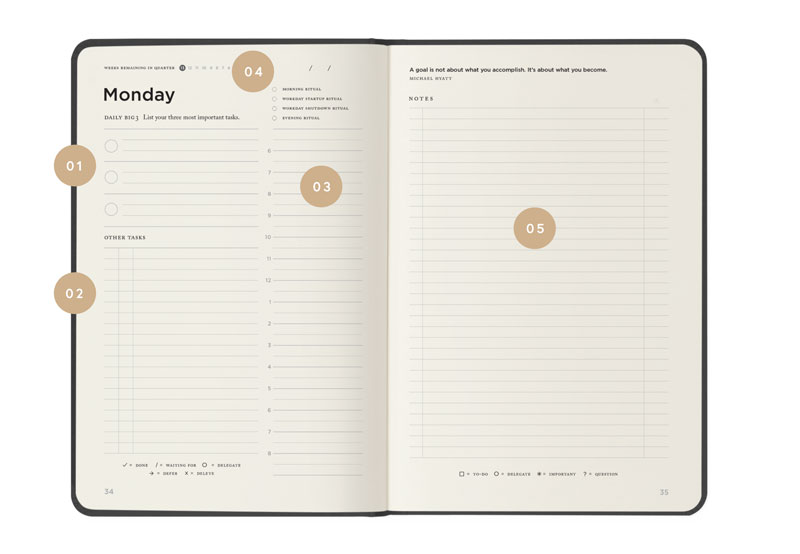
There's so much more to unpack with the Priority Filter, but that's a good start. I recommend you use it this week as the criteria for what ends up on your Weekly Big 3 (as a part of the Weekly Preview process in the Full Focus Planner), and each day, as you choose your Daily Big 3 on the Daily Pages in your planner.
You'll be amazed, I think, by how enormously clarifying this is, and how it instantly lightens your load since very few things will meet all three criteria. I run this exercise each and every day. It's fast and effective. I think you'll find that too.
My Question for You Before We Go
Tell me one thing you wished you had more time to invest in but currently don't. What is it? Could be personal or professional.
I can't wait to see what it is for you.
AI Disclosure: This newsletter was written by a human—me—for a human—you! I sometimes use AI for research, to critique my writing, or to proofread before I publish. But the words I choose, the sentences I write, and the ideas I share come from my brain and out through my fingertips onto the keyboard before they find their way to your inbox. If that ever changes, I'll tell you. Thanks for reading, and thanks for being a human.
Last modified on August 26th, 2026 at 12:15 pm
Disclosure of Material Connection: Some of the links in the post above are "affiliate links." This means if you click on the link and purchase the item, we will receive an affiliate commission. Regardless, we only recommend products or services we use and believe will add value to our readers. We are disclosing this in accordance with the Federal Trade Commission's 16 CFR, Part 255: "Guides Concerning the Use of Endorsements and Testimonials in Advertising.