




Ever feel like no matter what you do, you just cannot get on top of things? Sometimes it feels like the world is almost conspiring against you to keep you buried, exhausted, and willing to trade your soul for another hour to try to wrap up the day before shutting your laptop and heading home for the night.
And to make matters worse, it seems like the overwhelm feeds on itself, until even the smallest tasks or decisions feel like too much.
You’re not imagining this. It’s a phenomenon I like to call The Overload Spiral, and it’s not just happening to you.
A few weeks ago, my husband Joel was out of town visiting his mom in California, who is in a nursing home after some serious health issues earlier this spring. Due to travel delays, he got into Sacramento later than expected, and we decided it made sense for him to stay a couple of extra days to make the trip worth the effort. That meant I was on my own with the kids for five days.
During that time I had very full days at work, along with back-to-school activities, two birthday parties, an away football game, and several personal appointments between the kids and me. It all worked when two of us were sharing the load, but it quickly became too much with only me.
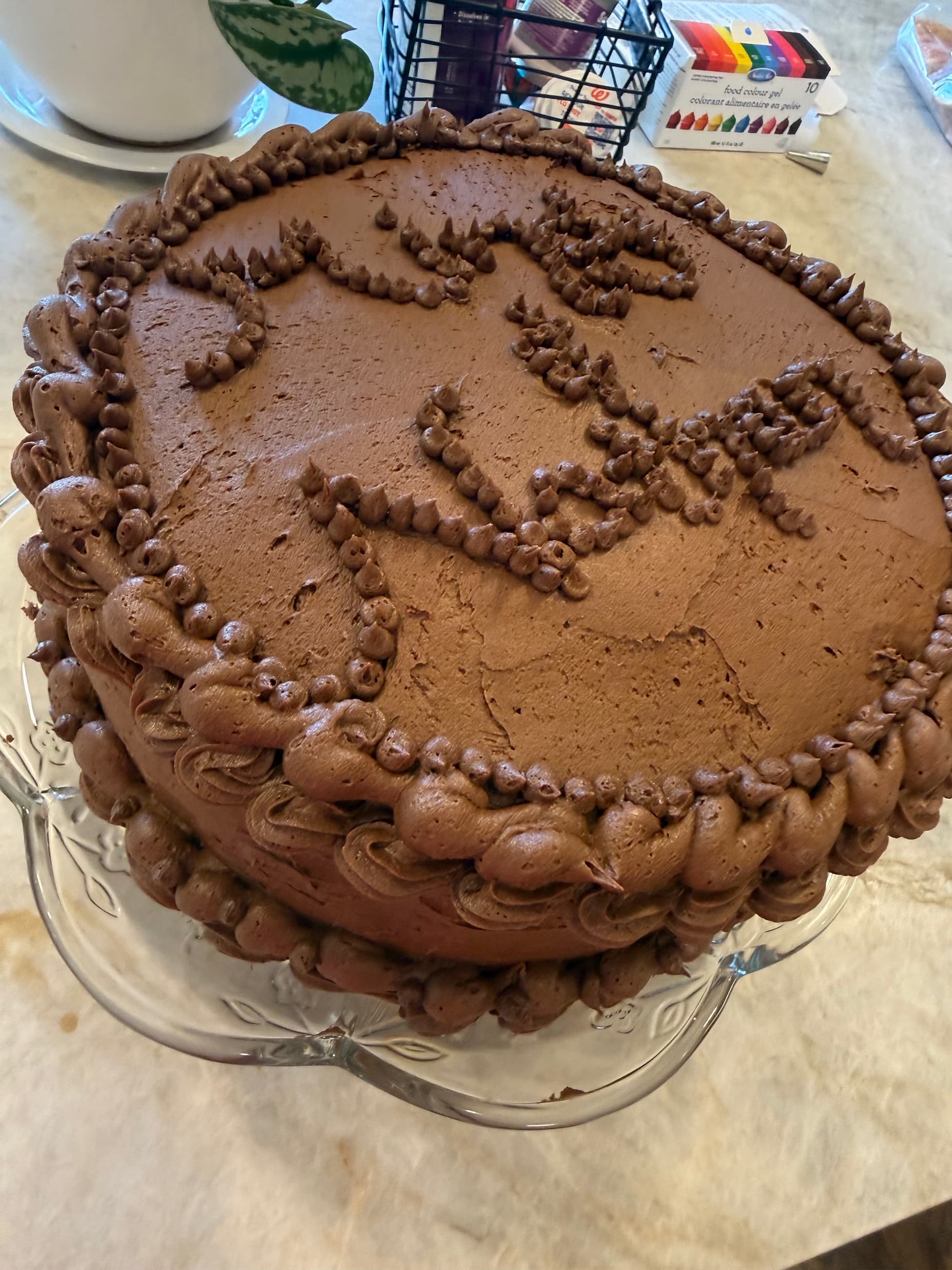
The cake I made for my sister and her husband (who have birthdays just days apart). It’s our family’s signature yellow cake with mocha buttercream frosting.
I did my best to keep up, but before I knew it, I was leaving work early to accommodate family commitments and working at night to make up for what I had missed during the workday. I was starting tasks and leaving them unfinished midway through. I was forgetting things, showing up late for meetings, and dropping balls all over the place. I was overwhelmed.
In my case, the temporary surge in demand on my time without a subsequent surge in my capacity created this problem. Thankfully, that was quickly resolved when Joel came home, load-sharing resumed, and equilibrium was restored to our lives (and my schedule!).

Attending the away football game by myself while Joel was out of town.
But, often, this is not temporary. In fact, it’s possible this kind of overwhelm is the water you’re swimming in every day and you don’t know how to get out. That’s where it’s helpful to understand what is actually happening.
We think what we need is more time, but what we actually need is more clarity. Let me explain the Overload Spiral we often find ourselves in.
First, a definition. Overload is simply having too much to do and not enough time to do it in. We all know this experience well, don’t we? The spiral works like this.
First, you notice how packed your calendar is, and you think, How am I going to get all of this done? Then, you think to yourself, “I’m not sure I can.” But then you say to yourself, “But I don’t really have a choice because everything is important!”
From there, you think, “My gosh, I am juggling too much!” And, then, predictably, “There’s not enough time to get all this stuff done!” Even more predictably, you start dropping balls. You’re late for meetings, you forget to answer the time-sensitive email, you don’t leave time to create the report you have to present in the morning, and so on.
Then, the shame and blame start. You think, “Why in the heck can’t I keep up? What’s wrong with me anyway?”
And then the spiral starts all over again. There’s no way out of this one other than to interrupt the pattern.
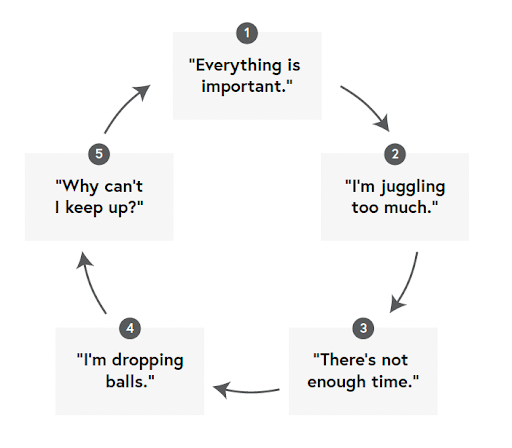
The Overload Spiral in action.
Why? Because you legitimately do have too much you’re juggling and as I’ve said in previous issues of the newsletter, there’s literally not enough time to get it all done. It’s a real conundrum to solve because there isn’t any more time to get; that is a fixed resource, and we all get the same amount.
That’s why you have to break this spiral with another tool besides time—and it’s the only one that works: Clarity.
While everything on your list that’s overloading your schedule is probably important, it’s not equally important. If we can get clear on what is most important, then we can deprioritize what is less important without many adverse consequences.
For example, during my crazy week while Joel was out of town, there was a senior parent orientation meeting scheduled for one of the nights when I also had an important medical appointment for one of our other kids. Neither was unimportant, but they weren’t equally important.
I thought about it and realized the parent meeting would likely be followed up with a detailed email on what was discussed since they couldn’t count on 100% attendance and everyone needed the information. I also knew several other parents who would attend, and figured I could get a download from them if all else failed.
On the other hand, the consequence of postponing the doctor’s appointment for our other child would have meant a costly regression in a treatment plan that was critical to their well-being.
Both were important, but there was a clear hierarchy once I thought about it. And that clarity allowed me to step out of the Overload Spiral and make a choice that got me off the crazy train, both in terms of my schedule and my psychology.
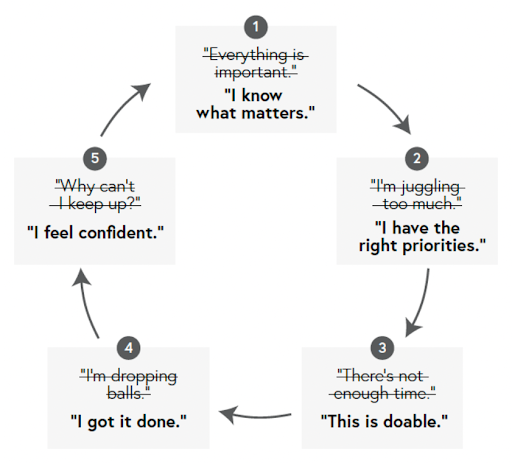
Breaking out of the Spiral.
I didn’t feel guilt for not attending the parent meeting. After all, the point wasn’t going to the meeting; it was making sure I was on top of understanding graduation requirements, the college application process, and so on—all of which I could do asynchronously.
Without trying to be in two places at a time, and knowing with confidence I had chosen the right thing to focus on with my limited resources and most important priorities in mind, I was able to be present with the doctor and our child, then drive guilt-free through Chick-fil-A on the way home for dinner and still get everyone to bed on time, including myself. Crisis averted.
Clarity won’t add hours to your day. But it will tell you which balls you’re allowed to drop—so you can keep the ones that matter and jump out of the Overload Spiral before it starts spinning again.
AI Disclosure: This newsletter was written by a human—me—for a human—you! I sometimes use AI for research, to critique my writing, or to proofread before I publish. But the words I choose, the sentences I write, and the ideas I share come from my brain and out through my fingertips onto the keyboard before they find their way to your inbox. If that ever changes, I’ll tell you. Thanks for reading, and thanks for being a human.
Last modified on September 29th, 2026 at 12:01 pm
Disclosure of Material Connection: Some of the links in the post above are "affiliate links." This means if you click on the link and purchase the item, we will receive an affiliate commission. Regardless, we only recommend products or services we use and believe will add value to our readers. We are disclosing this in accordance with the Federal Trade Commission's 16 CFR, Part 255: "Guides Concerning the Use of Endorsements and Testimonials in Advertising.