




The plane doors closed at exactly the wrong moment.
I was boarded, bound for Portland, Oregon—our oldest daughter was getting married the next day—when the text came in from our pediatrician. The high fever our youngest had been running all day probably wasn’t the UTI we’d discussed that morning. More likely, it was a flare of the life-threatening immune reaction that had put her in the hospital for five days the previous December.
My baby was heading to the ER, and I was heading 2,500 miles away in the opposite direction.
She was stable. Her godmother was with her. We decided to proceed with the wedding, but left halfway through the dinner reception we were hosting to catch a red-eye back to Nashville. We were at the hospital by early morning.
Thankfully, this flare was not nearly as severe as the prior episode—her body self-corrected without steroids. She was released Monday afternoon and was back in school by Tuesday like nothing ever happened. Meanwhile, I am not. Back at work, that is, like nothing ever happened.
If you’ve followed along here for a while, you know our family has been navigating a long season of medical trials—the kind that pile up quietly until the weight becomes unmistakable. This was one crisis too many in too short a stretch. When I got home from Portland, my body told me, in no uncertain terms, that it was done.
It felt like trying to hit the gas pedal in your car expecting to hear the engine rev, but instead . . . silence. “You can decide to stop” my therapist told me, “or your body can stop you on its own timeline. That’s the choice.”
I knew I needed to pull back—not from 30 to 25 hours a week, I’ve worked around 30 hours for more than a decade—but dramatically, at least for a period. More like 15 hours for the next couple of months. Slow mornings, therapy, walks, time in the garden. Naps, even. The kind of recovery schedule that felt almost absurd to consider when I’m also the CEO of a company with real people counting on me.
And that’s when it got interesting, because I thought my problem was logistics.
Hint, It’s Not the Logistics
It wasn’t. When I actually sat down with why I couldn’t bring myself to step back, two things surfaced, one right underneath the other.
The first was practical: Who’s going to handle this? Can my team actually manage? The stakes are too high to just find out. That layer felt solid and defensible, like a real reason.
But when I started honestly working through the logistics—yes, actually, they can handle it; yes, there are people; yes, the work will get done differently but it will get done—a second, much more embarrassing thing showed up underneath.
Who am I if I’m not the one carrying it?
If I’m not the person who shows up with a cape on every time. If I’m not the one who absorbs the hit and figures it out when no one else can. If I don’t have the badge of burnout to point to—then what, exactly, is my value? What do I bring to the world if I’m just a normal human person with limits who needs rest like everybody else?
That is not a logistics problem. And it was sitting right underneath the logistics problem the entire time, just waiting for me to get quiet enough to find it.
And underneath that is something I’m kind of embarrassed to tell you, but I’m going to anyway, because I suspect you might have your own version of it.
I have what I call my Dust Bowl.
My Dust Bowl
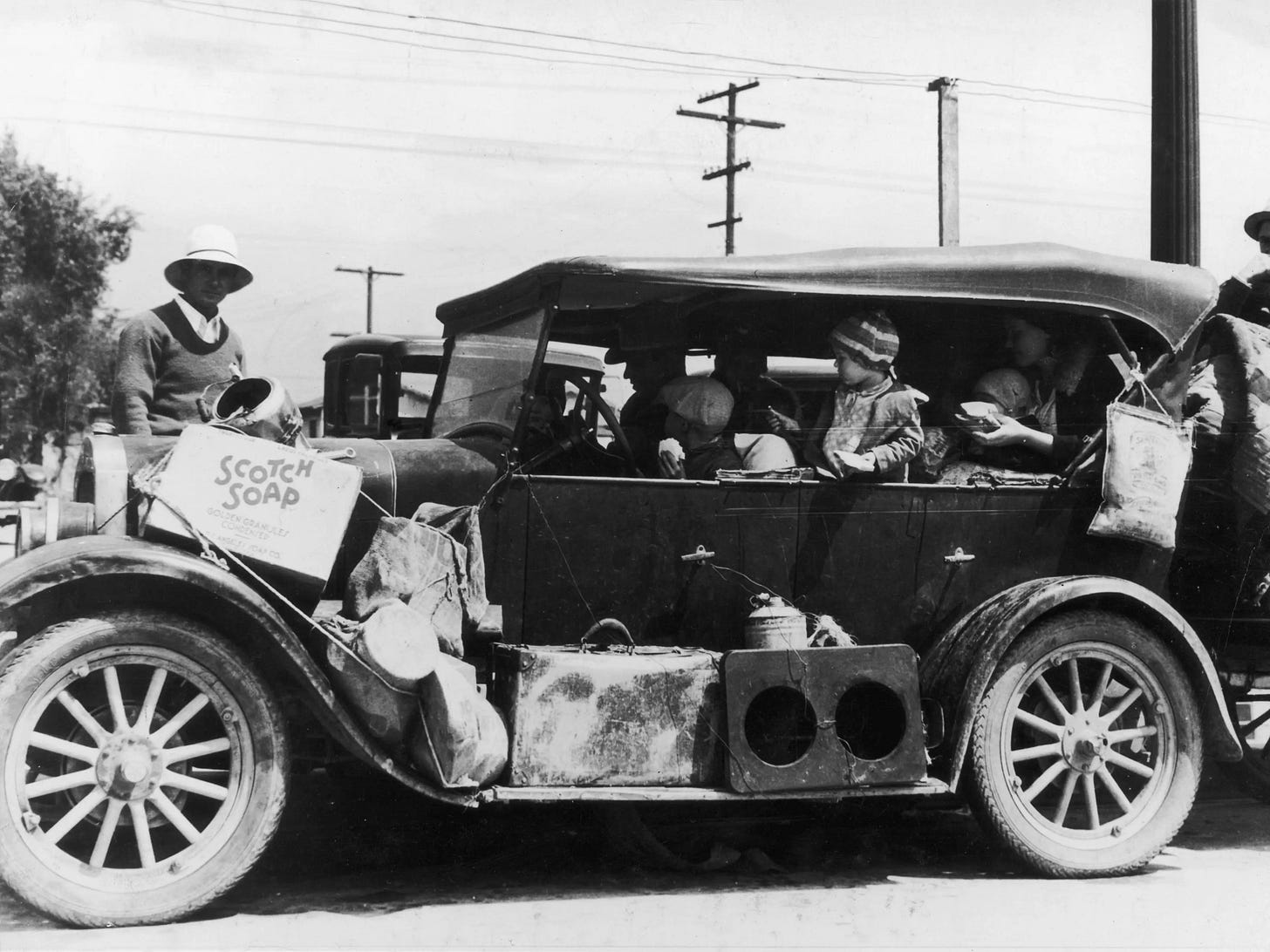
When my financial anxiety gets triggered—sometimes by something real, sometimes by a thought I have in the shower about a bad thing that could theoretically happen—I can be inside a full Depression-era scene in about thirty seconds. Black-and-white photograph. Kids in a rusted-out car. Little aluminum pans with something resembling soup-kitchen mush. Tent camp somewhere in the California desert. Everyone’s dirty and nobody’s okay.
It sounds almost funny when I describe it out loud. It is, and it isn’t. Because that image—completely irrational, entirely disconnected from my actual circumstances—is what keeps the whole machine running. The constant researching, the compulsive problem-solving, the inability to delegate anything that touches money or my children, the low hum of no one is coming, this is up to you that runs underneath everything I do.
The old spiritual writers would call this a besetting sin—not so much a moral failure as a dysfunctional coping strategy so entrenched you forget it is one. My particular besetting sin is self-reliance, and the truly sneaky thing about it is that it can look completely fine on paper. I delegate with the best of them. I don’t micromanage. I work a reasonable number of hours. It looks great—until you hit the moment when the weight is finally too much for the frame to hold, and the whole house of cards comes down at once.
That’s where I’ve been.
What finally cracked this open for me was a thought I kept coming back to. If my doctor called tomorrow and told me I had a serious cancer—survivable, but only if I committed fully to recovery—I wouldn’t hesitate for a second. I’d make the decision and figure out the logistics later. I did it when we adopted our boys and I had to restructure everything so I could be home in the afternoons. It was nonnegotiable. I made it work.
Practical Atheism
My nervous system is not a cancer diagnosis. But it is a real medical situation. And it’s asking me to do the same thing—to treat this as nonnegotiable. The question was whether I was willing to do that.
When I talked to my dad about all of this, he said something that stopped me cold: “It’s easy to live like a practical atheist.”
Yuck. But he’s right.
He meant it’s easy to live as though your effort is the only force working on your behalf. As though outcomes depend entirely on your vigilance, your capacity to hold it all together, your willingness to white-knuckle your way through every hard thing. As though the good things in your life exist because you worked hard enough for them—and will disappear the moment you stop.
That’s how I’ve been living. And the honest reckoning is that it’s not even accurate—I didn’t earn my way into most of what I have. The belief that it all depends on me, that nothing good holds together unless I’m the one holding it? When you say that out loud, it’s just kind of gross. Worse, it’s a prison. And even worse than that, it’s utter foolishness.
What Trust Actually Looks Like
For me, what this looks like on the other side is learning to trust God—specifically, that I am seen, that I am held, that provision doesn’t depend entirely on how hard I grip. That He “knows my frame and remembers that I am dust” (read: finite and human) and delights in providing for my needs in the same way, though so much more, that I do for my own children.
Now, if religious language doesn’t map onto your own framework, I’d invite you to sit with this question instead: What are you pretending is entirely up to you that isn’t? Because I think the territory is the same regardless of what you call it.
Here’s what I’ve come to believe: Self-reliance will only ever get you survival. That’s it. The whole function of self-reliance is to avoid acknowledging your vulnerability—to avoid the risk of trusting anyone or anything else to show up for you in ways you can’t show up for yourself. It feels like more courage than you have to open that hand. But an open heart is the only way a heart can experience meaning, joy, beauty, and real connection.
You cannot live your life primarily through the lens of emotional risk management and expect to flourish. A white-knuckled fist can hold on tight, but it can’t receive anything.
Your Version of The Challenge
I don’t know what version of this is running in your life right now. Maybe it doesn’t look like overwork at all. Maybe it’s a medical issue, or a financial one, or the tsunami of AI and what-in-the-world-does-that-mean-for-my-business. Maybe it’s a broken relationship, or figuring out how to care for aging parents. Most likely, it’s several big things at once.
And this is when our self-reliance house of cards falls down. At some point, the weight is too much for the frame to hold, and it collapses. And when it does, we get to make a choice.
So let me ask you this: If you get quiet enough to look—not at the logistics, not at the to-do list, but underneath all of it—what’s actually driving you? Because if you look, I think you’ll find your own version of the Dust Bowl. Your own identity question. Your own coping strategy that’s been dressing itself up as something more noble than it actually is for a very long time.
And when you find it, you get to decide: Do I want to go on like this, or do I want to choose something different?
I’m stepping into a season of deliberate less. And honestly, it scares the hell out of me. Every day for the next few months, I’m going to have to put my literal money where my mouth is and believe that the business will hold, that my children will be okay, that the world will keep turning even if it’s not by the strength of my own two hands.
Maybe that’s the gift of hitting the wall. Maybe being disabused of a lie you’ve lived inside for a long time is the greatest gift you can ever be given. Because the alternative is to live under its tyranny forever.
Sit with that one for a minute. What’s one thing you’d stop carrying tomorrow if you actually believed it would be okay without you?
Last modified on April 28th, 2026 at 9:32 am
Disclosure of Material Connection: Some of the links in the post above are "affiliate links." This means if you click on the link and purchase the item, we will receive an affiliate commission. Regardless, we only recommend products or services we use and believe will add value to our readers. We are disclosing this in accordance with the Federal Trade Commission's 16 CFR, Part 255: "Guides Concerning the Use of Endorsements and Testimonials in Advertising.
